Dholakia Foundation
Philanthropy &
Social Impact
Water, trees and employee welfare — the documented work of the Dholakia Foundation and of Hari Krishna Exports, with figures attributed to their sources.
Amreli district is not an abstract cause. It is where Dholakia was born, and the place whose failing water table sent his generation to Surat in the first place. The Foundation’s central programme is, in that sense, an attempt to remove the reason he had to leave.
Water
Mission 100 Lakes
The Foundation’s best-documented project created one hundred water bodies along roughly fifty-three kilometres of the Gagadiya river, between Chamardi and Krankach in Amreli district. Rather than a single large dam, the approach uses a chain of smaller reservoirs and check dams that slow the monsoon run-off and allow it to recharge groundwater along the length of the river.
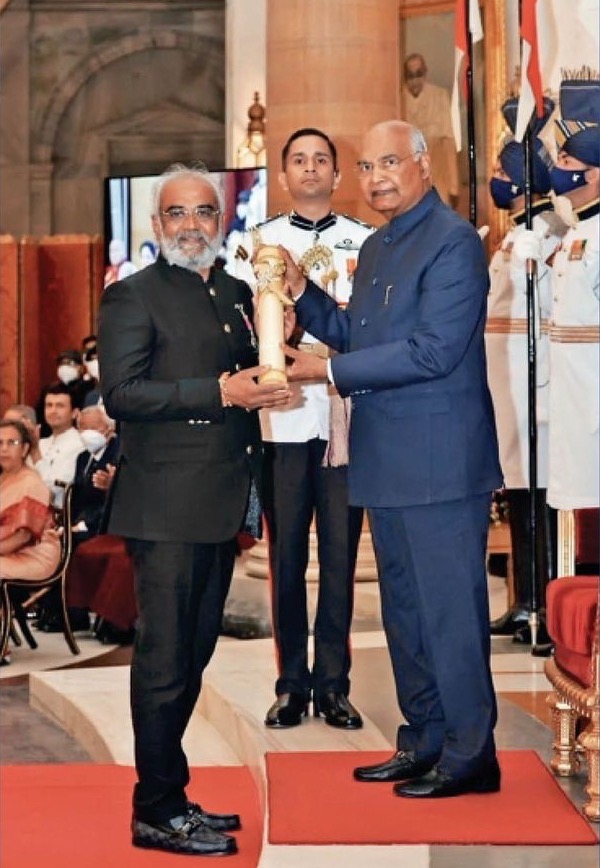
In March 2023 a check-dam foundation-laying ceremony at Luvariya was attended by the former President of India, Ram Nath Kovind, and the Governor of Gujarat, Acharya Devvrat. In the same month the programme was presented at the United Nations 2023 Water Conference in New York. In January 2024 the Foundation launched Mission River, extending the approach to river restoration elsewhere in India.
Reservoirs created along the Gagadiya river under Mission 100 Lakes
Lakes reported restored across India by the Foundation
World Diamond Council, 2024
Stretch of river addressed, from Chamardi to Krankach in Amreli
Farmers and residents reported as benefiting from the restored water bodies
Reported volumes of water conserved vary between sources — from around 13 billion litres in a 2023 account to 25 billion litres or more in later reporting — and are given here as a range rather than a single figure. Sources are listed on the Media page.
Outcomes
What the water work has changed
Figures as reported by the Dholakia Foundation and the World Diamond Council. Independent verification of outcome percentages is not publicly available, and they should be read as the Foundation’s own assessment.
Inside the company
Employee welfare
The most photographed element of Hari Krishna’s social programme is its annual Diwali recognition scheme, run every year since 2011. In 2014, the year that attracted the widest international coverage, the distribution comprised 491 cars, 200 apartments and 525 pieces of diamond jewellery. Later years have continued at comparable scale; reported totals differ between outlets and are best read as approximate.
Less visible, and arguably more consequential, is the routine provision: free annual full-body health checks for employees, wellness and mindfulness programmes, and company-organised blood-donation drives — one, marking the company’s thirty-second year, collecting 910 units across Mumbai and Surat.
The Foundation has also reported scholarship provision, health and wellness camps, and mass wedding ceremonies organised for employees and their families.
The Foundation’s stated areas of work
Ecosystem restoration
Lake and check-dam construction, river rejuvenation and large-scale afforestation, concentrated in Gujarat and extended nationally through Mission River.
Education
Scholarship support for students, reported by the Foundation as a continuing programme alongside its environmental work.
Health
Health and wellness camps in the communities where the Foundation operates, in addition to employee health provision inside the company.
Women’s empowerment
Listed by the Foundation among its principal areas of activity.
Community welfare
Mass wedding ceremonies and community support programmes organised for employees and residents of the areas where the group operates.
Youth
A youth stream, presented by the Foundation alongside its ecosystem-restoration and Sustainable Development Goal programmes.