Philosophy
Leadership
A management position argued in public over three decades: that the product is a by-product, and the people are the business.
“Hum diamond nahi banate… hum aadmi banate hain. Diamond toh byproduct hai.” Savji Dholakia, in a filmed interview — “We don’t make diamonds; we make people. The diamond is the by-product.”
Where it came from
A philosophy with a commercial origin
It would be easy, and wrong, to read Dholakia’s employee programmes as pure benevolence. He has been consistent about their origin: the company trained diamond workers from nothing, and larger firms then hired them away. Competing on salary alone was a losing position. So he changed what was on offer.
What makes the story instructive is not the generosity but the reasoning. In a craft industry, skill lives in individual hands. A cutter with fifteen years of experience cannot be replaced by a new hire at the same wage; the firm loses judgement it has paid to develop. Treating retention as a capital-preservation problem rather than an HR one leads to a different arithmetic — and, eventually, to a car park full of cars at Diwali.
Dholakia’s summary of the return is characteristically compressed:
“Jitna dete hain, utna zyada milta hai.” “The more we give, the more we receive.”
Four positions he has argued consistently
Long horizons beat quarterly ones
The water programme in Amreli was begun without a completion date and has run for the better part of two decades. A check dam pays back over a generation, not a financial year. The same patience is visible in the business: manufacturing has stayed in one city, ownership has stayed in one family, and the brand launched in 2005 was given years to reach scale.
Hardship has to be taught, not described
In 2016 Dholakia sent his son Dravya, then twenty-one, to Kochi for a month with ₹7,000 for emergencies only, forbidden to work anywhere longer than a week or to use the family name. Reported accounts describe some sixty rejections over five days before work at a bakery, a call centre, a shoe shop and a McDonald’s. His stated intention was direct: “I wanted my son to learn the value of money, and to deal with challenging situations in life.”
Welfare belongs in operations, not in a foundation report
Free annual full-body health checks, wellness and mindfulness provision, and company blood-donation drives — one collecting 910 units across Mumbai and Surat — sit inside ordinary company practice rather than in a separate corporate-responsibility function. The distinction matters: programmes that live in operations survive downturns better than programmes that live in a budget line.
Persistence is the scarce input
Asked about the difficulty of ecological work, his framing was about endurance rather than technique: “Grit will test your patience, and so will Mother Nature.” It is the same disposition that produced a hundred reservoirs on a single river and ten consecutive export awards — results that come from repetition rather than from a single decisive move.
In practice
What the philosophy costs
None of this is free. A recognition programme running annually since 2011 is a permanent claim on profit, and one that ratchets: having given cars one year, the company cannot quietly give less the next without it being read as decline.
The same is true of the ecological work. A hundred reservoirs require land, permissions, engineering and maintenance long after the ceremonies are over, and the returns accrue mostly to people who do not work for the company.
The consistency is the point. A commitment that survives two decades and several business cycles is a different kind of statement from one announced in a good year.
For entrepreneurs
Four things the record suggests
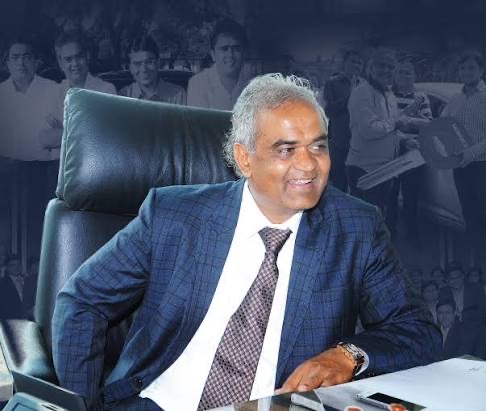
“I clearly remember the happiness those paltry savings had given me: it is nothing less than how I feel today.” Savji Dholakia, on the ₹39 he saved from his first month’s wage